May 15, 2008

blossoming

           Blossoming2


asparagus rhubarb strawberry

        Rhubarbwildstrawasparagus_003ps

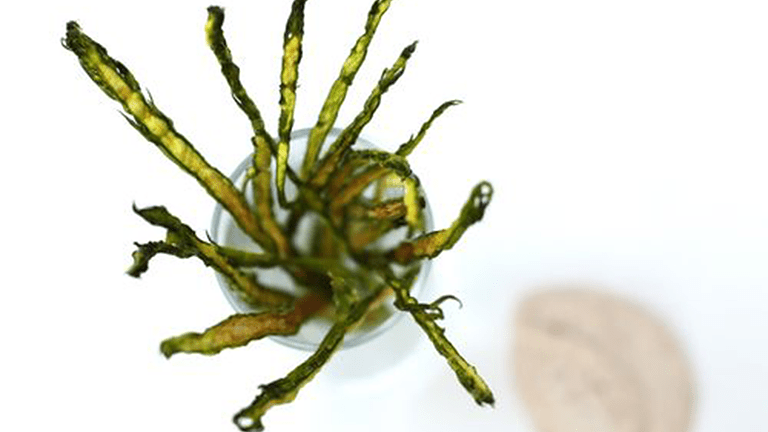
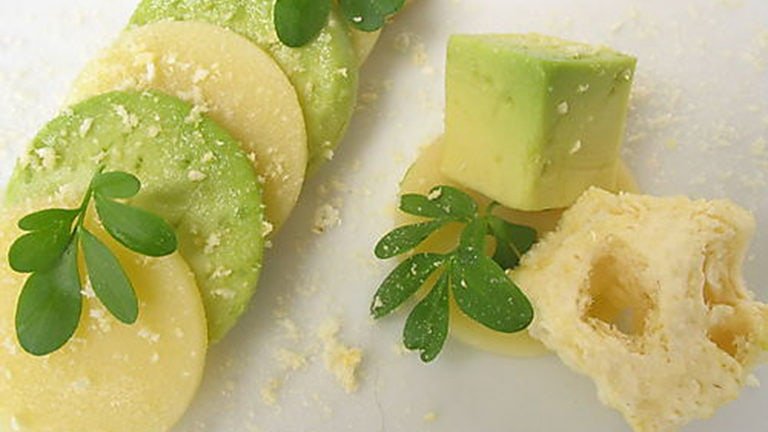
Not quite ready to move on from the pairing of asparagus and rhubarb, I've decided to play them on the sweet side with the first of the fraises de bois. Rhubarb and strawberries are old friends.. but how to introduce asparagus? Going with fat as a flavor bridge, I blended asparagus puree into a mousse of lightly sweetened, whipped cream and cocoa butter.
Cocoa butter is a product that has great potential as a neutral-flavored fat that behaves like chocolate. Unlike chocolate, it is pure fat and has eluded me in my attempts to emulsify it with a water base. (Thanks- Dave Arnold- for introducing me to mono- and diglycerides). Here, that was not an issue, as the melted cocoa butter readily blends with cream, acting like a gel that firms and stabilizes. In this arena, the asparagus contributed a subtle herbal flavor that blended nicely with the rhubarb and strawberries.
Makes me wonder...what other obvious/not-so-obvious flavor pairings am I missing?


May 12, 2008

asparagus and rhubarb

Emissaireasparagusrhubard_007ps_2

"What grows together goes together"
We've all heard this adage...but is it the organizing principle behind the world's cuisines or is it just a guideline?

Here in the Northeast, our growing season is just getting started...too soon for farmer's markets, but there is some local produce beginning to show up in grocery stores. In my own garden, the only things that are harvestable in the beginning of May are some perennial herbs (chervil, mint, chives, parsley, and lovage) and a few vegetables (peas, lettuce, wild arugula that has reseeded, asparagus, rhubarb, and wintered-over leeks). The fraises de boise, or alpine strawberries, have just begun to blush, which means that with a few days of warm weather, I can head out to the patch with a bowl of cereal and enjoy breakfast al fresco.
Examining this bounty, the combinations become obvious: peas with mint, tender salads of lettuce, arugula, and herbs, asparagus with leeks and parsley... but what about the rhubarb? Certainly, rhubarb and strawberries are a classic and sound pairing, but rhubarb is in fact a perennial vegetable that grows from crowns in the form of fibrous stalks and beneath it's bracing acidity, there is an earthy, grassy flavor. Does this sound a lot like asparagus? My thoughts exactly.

While I could find no botanical or flavor correlations aside from those already mentioned, the combination intrigued me enough to warrant some play. It was not all fun, though. My first attempt--a dish of poached scallops with a compressed sheet of thin ribbons of asparagus and rhubarb--while beautiful to look at, fell short on flavor. Trust me on this, even the dog wouldn't eat it. But failure is never a loss when it allows you to push forward an idea. With the scallop dish, I learned that the elements of sweet and fat were necessary to unite the flavors of these two vegetables.
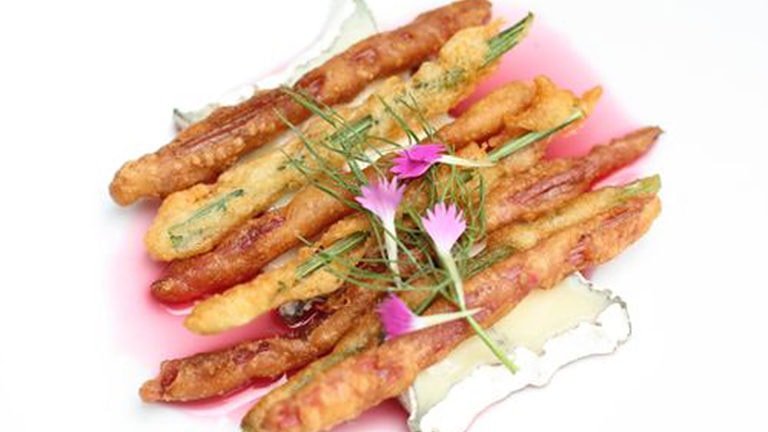
Enter Bouc Emissaire, a creamy and mild goat cheese from Canada. The pairing of asparagus with goat cheese is an established one, but in order to bring rhubarb into the equation and not allow it's acidity to compete with the tang of the cheese or overwhelm the asparagus, it needed to be balanced with sugar. Texturally, I did not want the elements to contrast, but to melt together, so I chose to manipulate their texture with hydrocolloids. Seasoned asparagus juice was set with gelatin, and rhubarb juice was gently sweetened with agave nectar and set with high and low acyl gellan gum. The final flourishes were a scattering of chamomile blossoms and a madeira reduction that was rubber-stamped on the plate.

In conclusion, I think that this dish supports the wisdom of honoring seasonality when combining flavors. The proof is that I enjoyed every morsel, while my dog watched longingly.

May 08, 2008

fissure

Interesting article on anarchy, autocracy, and censorship at the CIA (no, not that CIA). It seems that for  $25K/yr, chefs-in-the-making are learning to cook frozen waffle fries. Must be some damn good waffle fries?

May 07, 2008

smoked salmon sushi rolls

cut into a side of smoked salmon... slice off a perfect thin sheet...observe it's intrinsic beauty; striations of fat and flesh...inhale it's aroma, redolent of smoke and sea...taste it's silky complexity...listen as it tells you what it wants to be....
Sushi_002_2

smoked salmon roll:
4" x 5" sheets of thinly sliced smoked salmon
cucumber brunoise
miso saikyo (white miso)

Smear a thin layer of miso in a 1" wide strip along one long edge of salmon sheet. Sprinkle cucumber over miso. Roll salmon along covered edge to enclose miso and cucumber, stopping halfway. Plate.

avocado roll:
peeled and pitted avocado halves

Place cucumber halves on flat surface, rounded side up. Repeatedly poke a 1/2" diameter straw or pipe through avocado, stacking disks of avocado into straw. When nearly full, stand straw upright on flat surface and insert a 1/2" dowel into top of straw, pressing firmly to compress avocado. Line up edge of straw next to the top edge of salmon roll on plate. Push with dowel to extrude avocado roll while pulling away straw. Trim ends to align with salmon roll.

sushi and tabiko roll:
2 cups whole milk
1 tsp salt
1 tsp sugar
1/4 cup raw sushi rice
rice wine vinegar
mirin
tabiko

Place milk, salt and sugar in a saucepan and bring to a boil. Stir in rice, cover, and lower heat to a simmer. Cook until rice is very tender, about 25-30 minutes. Puree mixture while hot, then press through a tamis. Allow mixture to come to room temperature, then season with vinegar and mirin, balancing the flavor, but leaving it assertive, as it will mute when chilled. Line a 3/4" diameter cylindrical mold with acetate. Fill with rice mixture, taking care to not leave air pockets. Wrap cylinder in plastic wrap to seal ends, then freeze just until firm enough to unmold. Unmold cylinder and roll in tabiko to completely cover. Set on plate next to avocado roll and trim ends. Place plate in refrigerator to allow sushi roll to thaw and soften.

furikake:
2 sheets toasted nori, crumbled
1 Tblsp toasted sesame seeds

Combine nori and sesame seeds. When ready to serve, lay a strip on plate next to unrolled edge of salmon.


Sushi_007ps

May 05, 2008

workshop

Yesterday, I attended a high-tech dessert workshop at the French Culinary Institute, led by Dave Arnold and Nils Noren. Dave Arnold is a self-proclaimed gadget geek who works directly with Wylie Dufresne and other avant guarde chefs in NYC as their culinary tech support. He is neither a chef nor a scientist, yet his knowledge of food history and chemistry is vast and formidable. Nils Noren is a Swedish-trained chef, former Executive Chef of Aquavit, and current VP of Culinary Arts of the FCI. Together, they form a dream team with chef Noren's classic background, modern approach, and assured manner playing off of Arnold's frenetic free-flow of technical information.
5_4_08_pg1_2
The workshop consisted of demonstrations of three desserts and one savory dish, each followed by a tasting. The equipment used included a commercial vacuum sealer, a pressure cooker, a pacojet, and a rotary evaporator. The vacuum was put into service to quickly remove bubbles from blended hyrocolloid solutions, a process which usually requires many hours of settling time, to fully pickle red onions in a matter of minutes, and to infuse heavy cream with the smoky flavor of Lapsang Souchong tea without the use of heat. The legendary Durian was cooked in the pressure cooker, then processed into a silky ice cream in the pacojet. This ingredient excited me above all others as it was my first experience with "the king of fruits". I found it strangely wonderful, though not everyone present shared this opinion. The rotovap, a piece of laboratory equipment that Arnold salvaged and then jerry-rigged into a distiller that will extract pure, crystal-clear, liquid essence from anything he desires. It differs from a traditional still in that it uses carefully controlled low temperatures to preserve the flavor and aromas of the resulting elixir. The products in yesterday's workshop were clear brandies, or eau de vies, of two wines:  Madeira and  Beaumes de Venise. Their flavor and alcohol content (up to 130 proof) were intoxicating. Arnold was quick to point out that the process of privately distilling alcohol is illegal.

Other revelations were puffed pasta, a simple technique that is worthy of it's own future post, and the introduction of red lime paste (made from red slake lime--the mineral, not the fruit), a product that Arnold recently discovered serendipitously. It is alkaline, like baking soda, and was used to soak under-ripe bananas in order to allow them to caramelize and retain their shape. To me, the highlight was the 15 minutes after the workshop where Dave Arnold allowed me to pick his brain with questions about products, applications, and techniques that interested me. I could not write fast enough to keep up with his onslaught of information. He drew me into his maelstrom and gave me a new horizon of possibilities, leaving me awed by how much there is still to learn and discover.

Time to go destroy my kitchen.

May 02, 2008

flower power

              Flowerpower_061

On more than one occasion, I have been accused of being a hippie.The finger is usually pointed by my children after one of my long-winded dissertations on the importance of recycling, composting, and energy conservation. I do not take offense at being called a hippie, but I remind them that I missed that boat and had I been born earlier, I would have fit right into a culture that protested war with the power of flowers.

Flowers do indeed have power; they evoke emotions, trigger memories, convey language, and stimulate the senses. The latter is usually associated with sight and smell, but flowers also have flavor.

Roses belong to the family Rosaceae which includes raspberries, strawberries, cherries and almonds, and are all aroma with tender,  mildly sweet petals. Violets contain ionone, a flavor compound that is also shared by carrots. Jasmine contains indole, which is also present in liver. Carnations have a distinct spicy clove flavor. Pansies taste grassy, with hints of wintergreen. Hibiscus have an acidic flavor that is reminiscent of cranberries. Daylilies are mildly sweet with melon and pear tones. Chamomile tastes like green apples. In contrast, Nasturtiums are pungent and peppery. Herb flowers usually mimic the flavors found in their leaves, in a milder and sweeter version. Most fruit and vegetable flowers are edible and, in fact, broccoli, cauliflower, and artichokes are actually flowers.

The history of cooking with flowers can be traced back thousands of years. Dandelions were one of the bitter herbs in the Old testament. The oldest surviving cookbook by the Roman Apicius featured a recipe for brains with rose petals. And the Victorians were fond of decorating confections with violets and pansies.

Modern chefs are rediscovering the power of flowers. Honey_flowers_and_pistachio_el_bull In Spain, Ferran Adria uses the flavor of flowers prominently in his evolving collections of thought-provoking dishes. In his Papel de Flores, (Flower Paper), he traps begonias, marigolds and herb flowers in cotton candy, or spun sugar, and compresses it to form an edible paper. In another dish, he covers a pistachio salad with caramelized rosemary honey air and up to 14 varieties of flower petals. Quique Dacosta of el Poblet infuses prawn stock with rose petals and texturized rose water in his celebrated Red Denia Prawn dish. Jordi Roca, the pastry chef at El Celler de Can Roca draws inspiration for his desserts from popular perfumes such as Calvin Klein's Eternity  and Lancome's Tresor by isolating the notes and recreating them with flavors on a plate. His Eternity dish is made up of vanilla cream, basil sauce, fresh and frozen mandarin, orange blossoms, maple syrup, and bergamot ice cream. When these components are eaten together, they evoke the scent of the perfume.

With a veritable garden of flowers at our disposal, waiting to be tasted and put to culinary use, is it just a matter of time before the consumption of flowers becomes as common as that of vegetables and herbs? That was a question that I recently posed to a chef/friend, who also happens to be a male. His reply and the ensuing conversation went like this:

"that'll never happen."

"why?"

"real men don't eat flowers"

"that's absurd...try telling that to Adria, Aduriz, Dacosta, and others. Aren't they real men?"

"no...they are culinary gods."

So...according to my chef/friend, only girls and gods eat flowers...that's good enough for me.

Flowerpower_021ps

spring flower salad
elderflower dressing
almond milk cream

April 30, 2008

silicone

                    Silicone_029

As a pastry chef, I've relied on molds to give shape to my desserts. I have a large collection which vary in size and shape from the very simple to the ornate and complex. Within the walls of my house, they cover shelves, fill entire cupboards, and lie waiting patiently in boxes. I cannot pick favorites (how can I...many have never been used), but I can tell you that nowadays, the ones that I use most often are made of silicone.

Silicone has revolutionized the way the I bake. Silpats are unparalleled in their ability to release anything that comes in contact with them. The flexibility of silicone molds allow me to form products which are perfectly smooth or deeply cut. The outcropping of new forms and shapes that I find on the market has had me already teetering on the precipice of possibilities.  Finding a product that allows me to make my own molds may have just pushed me over the edge.

I already have a collection of objects set aside to replicate in silicone, but I'm curious...what would you mold?

April 27, 2008

salmon passion fruit hollandaise

Salmonhollandaise03

My play with Transglutaminase continues after an intensive week of catering. Here I've made a salmon ravioli filled with passion fruit hollandaise. When I used to work the line, the hollandaise was made before service and kept in a warm bath. This didn't make sense to me and I insisted on making it to order, which pissed everyone off. They backed down when I proved that a perfect sauce could be made in the time that it took them to get their pans hot.

My entry into the world of cooking was through the sweet side. The skills that I have learned from baking have eased my transition to the savory side of the kitchen. I look for the moments when the two worlds collide and the transition feels seamless.

One day, while making a lemon curd, it occurred to me that I was essentially making a sweetened hollandaise. Although the cooking methods and proportions varies slightly between the two, the chemistry is the same in forming these egg-emulsified sauces. They share the same trio of key ingredients: egg yolks, fat in the form of butter, and acid in the form of lemon juice.  When isolating these ingredients and considering possible alternatives, it becomes easy to imagine flavor variations on the classic hollandaise. Egg yolks are unique in their protein coagulation, but acid can be introduced in the form of any fruit juice that has a PH of 3.0 or lower so as not to over-dilute the egg yolk. Candidates that fall in this range are: grapefruit, lime, cranberries, gooseberries, wild grapes, verjus, raspberries, rhubarb, pomegranates, tamarind, and passion fruit. These are all flavors that I've used to make fruit curds, so why not hollandaise? To bring it back to the savory realm, even the butter can be replaced with solidifying fats such as: foie, bacon, duck fat, serrano fat. Can you see where I'm going? Does this excite you as much as it does me?

For this ravioli, the hollandaise posed a challenge because it needed to solidify in order to glue the thin sheets of salmon around it, then to revert to it's fluid sauce state when reheated. A traditional hollandaise was not stable enough to endure the freezing and cooking process without curdling. I fiddled with a few additives and techniques before hitting on the simple addition of a small amount of gelatin. This allowed the hollandaise to firm up sufficiently without the need to be frozen, which I suspect had destabilized the emulsification, and to remelt in the sous vide bath.

Salmon_hollandaise_ps2


sous vide salmon ravioli filled with passion fruit hollandaise
crispy salmon skin
asparagus ramp puree
spiced rum beads

catering

Just another weekend gig

April252008_007_2

           April252008_012_2

April252008_033

April252008_016

             April252008_044

April252008_038

April252008_091

April252008_063

April252008_076

             April252008_082

April252008_113

What I learned was that the men and women who protect our communities, country, and leaders are very cool, generous, and love to eat.


Intro

  • Cooking, elementally, is controlling heat and moisture. The great cooks are masters of fire and water. Me, I'm still playing...welcome to my playground.
My Photo